-
The Challenge: Valuable Knowledge Hidden in Enterprise Documents
-
From Traditional Document Search to AI-Powered Knowledge Extraction
-
Making Technical and Operational Documentation More Accessible
-
How SenseTask Supports Intelligent Document Processing and Knowledge Access
-
- What is AI-powered enterprise document search?
- What is the difference between document search and knowledge extraction?
- Can AI search scanned PDFs and historical documents?
- How can AI improve contract and procurement document search?
- What is the difference between OCR search and semantic search?
- Is AI-powered document search reliable for enterprise use?
- Does AI-powered search replace document management systems?
AI-Powered Enterprise Document Search and Knowledge Extraction
-
The Challenge: Valuable Knowledge Hidden in Enterprise Documents
-
From Traditional Document Search to AI-Powered Knowledge Extraction
-
Making Technical and Operational Documentation More Accessible
-
How SenseTask Supports Intelligent Document Processing and Knowledge Access
-
- What is AI-powered enterprise document search?
- What is the difference between document search and knowledge extraction?
- Can AI search scanned PDFs and historical documents?
- How can AI improve contract and procurement document search?
- What is the difference between OCR search and semantic search?
- Is AI-powered document search reliable for enterprise use?
- Does AI-powered search replace document management systems?
Enterprises generate and accumulate vast amounts of documentation. Contracts, technical specifications, procurement records, legal agreements, operating procedures, and internal reports contain valuable information that supports daily operations and business decisions.
Yet, as document repositories grow, finding the right information becomes increasingly difficult.
Traditional document management systems help organizations store, organize, and retrieve files. However, locating a document is not the same as finding the specific information it contains. Employees often spend considerable time searching through folders, opening multiple files, and manually reviewing lengthy documents to find relevant details.
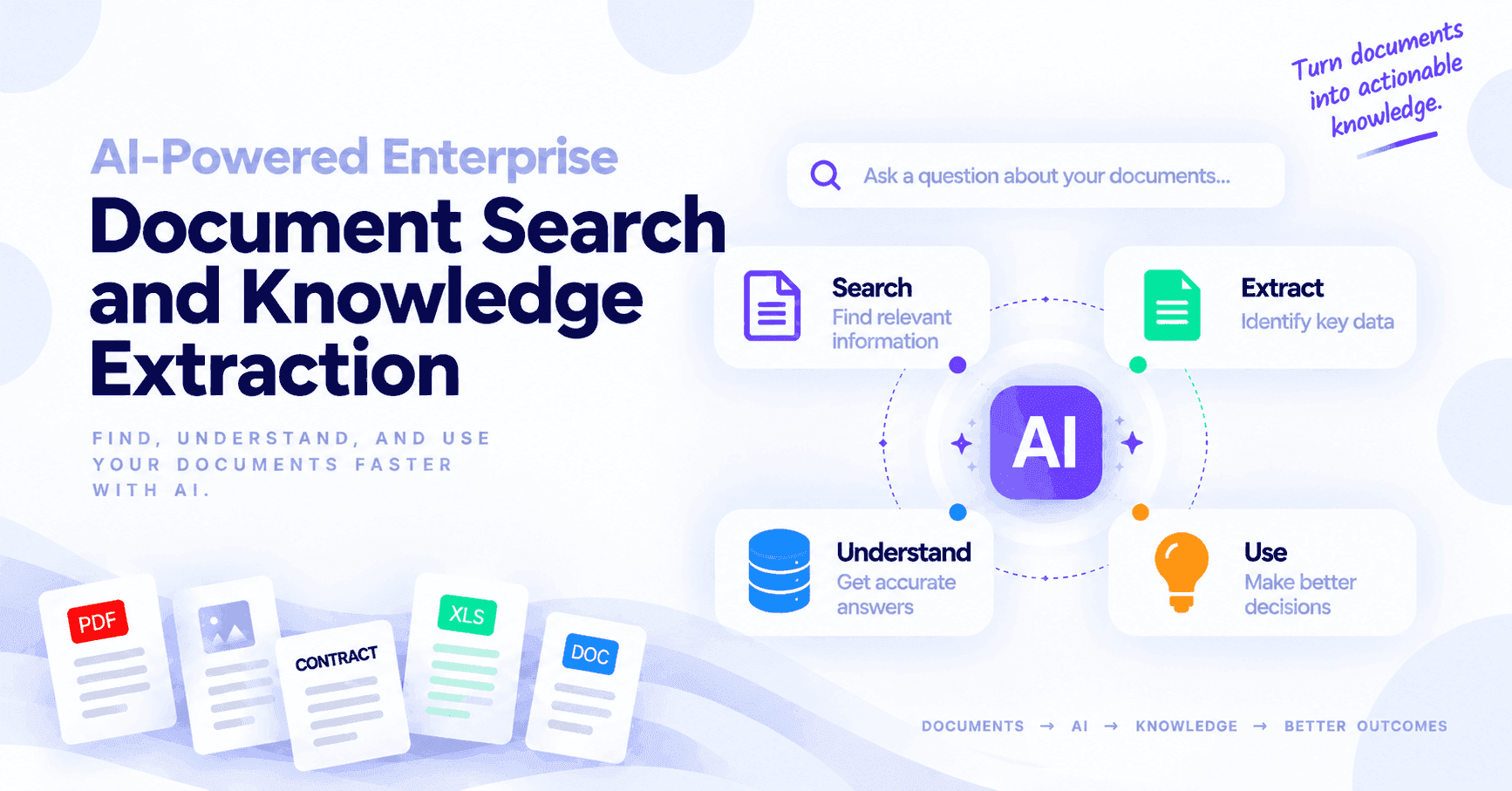
AI-powered document search and knowledge extraction are changing how enterprises access and use information. By combining intelligent document processing, automated data extraction, and semantic search, organizations can move beyond basic file retrieval toward making the knowledge contained in their documents more accessible.
The Challenge: Valuable Knowledge Hidden in Enterprise Documents
Large organizations typically manage documents across multiple departments, business units, and systems.
Legal teams maintain contracts and regulatory documentation. Procurement departments manage supplier agreements, tenders, and purchasing records. Technical teams work with specifications, maintenance manuals, and operating procedures.
Over time, these collections become extensive and increasingly difficult to navigate.
Even when documents are stored in centralized repositories, employees may face several challenges:
- Fragmented information: Relevant documents are distributed across different systems, departments, or storage locations.
- Limited search capabilities: Traditional search often depends on filenames, folder structures, or manually assigned metadata.
- Unstructured content: Important information is embedded in paragraphs, tables, scanned documents, and attachments.
- Time-consuming research: Finding specific contractual terms or technical requirements may involve reviewing numerous documents.
- Underutilized knowledge: Valuable information from previous projects, contracts, and procurement processes remains difficult to discover and reuse.
The challenge is not simply managing documents. It is making the information they contain accessible when it is needed.
From Traditional Document Search to AI-Powered Knowledge Extraction
Traditional document management systems typically rely on filenames, folder structures, and manually assigned metadata to organize and retrieve documents.
While these methods can be effective when users know what they are looking for, they become less practical as document volumes grow and information is distributed across large repositories.
Intelligent document processing introduces a more efficient approach by making document content searchable and automatically extracting relevant information.
With SenseTask, organizations can go beyond traditional document search through several capabilities:
- OCR-based content search: Search text recognized within scanned documents and PDFs, rather than relying only on filenames or manually entered descriptions.
- Automated data extraction: Extract key information such as supplier names, contract dates, invoice numbers, amounts, or other document-specific fields.
- Search and filtering by extracted data: Locate documents using automatically extracted information, reducing the need for manual indexing.
- Custom metadata: Attach additional metadata when needed to support document organization, classification, and retrieval.
For example, instead of searching for a contract by its filename, an employee can locate documents using extracted information such as the supplier, contract date, or other relevant fields.
These capabilities make document repositories more structured, searchable, and useful without requiring employees to manually categorize every document.
Taking Document Search Further with AI
AI-powered semantic search and knowledge extraction introduce another layer of functionality.
Rather than searching exclusively for specific words or structured fields, users can ask questions in natural language and retrieve information based on its meaning and context.
For example, an employee might ask:
“Which supplier agreements include annual price adjustment clauses?”
An AI-powered search system can identify relevant passages across multiple contracts, even when different terminology is used to describe similar conditions.
Knowledge extraction can go further by retrieving specific contractual obligations, comparing conditions across documents, or summarizing relevant information with references to the original sources.
The evolution is from finding documents by their attributes, to searching their content, to understanding and extracting knowledge from the information they contain.
These approaches complement each other. OCR, structured data extraction, and metadata provide a foundation for document retrieval, while semantic search and conversational AI make it possible to explore enterprise information in more flexible ways.
AI-Powered Search for Legal and Contract Documentation
Legal departments often manage large repositories containing contracts, amendments, legal opinions, regulatory documentation, and corporate records.
Finding specific information across these documents can be a time-consuming process, particularly when agreements span many years or involve multiple business entities.
AI-powered document search can help legal teams locate relevant contractual provisions without manually reviewing every document.
For example, users could search for:
- “Which contracts contain automatic renewal clauses?”
- “What are the termination notice periods in our supplier agreements?”
- “Which agreements include specific liability limitations?”
Instead of returning only documents containing exact keywords, AI-powered systems can identify relevant sections and present the information in context.
This can support contract reviews, compliance activities, legal research, and internal information requests.
However, AI-generated answers should remain traceable to their original sources. For legal and contractual matters, employees must be able to verify the relevant clauses and interpret them within the complete agreement.
Unlocking Knowledge from Procurement and Tender Archives
Procurement departments accumulate substantial amounts of documentation throughout their operations.
Tender specifications, supplier proposals, purchase agreements, technical evaluations, and historical procurement records contain information that may be valuable for future purchasing decisions.
However, retrieving this information often requires navigating complex folder structures or manually reviewing previous procurement processes.
AI-powered document search can make these archives more accessible.
For example, procurement teams could ask:
- “Which previous tenders included similar technical requirements?”
- “What payment conditions were used in contracts with comparable suppliers?”
- “Which historical agreements contain specific delivery or warranty provisions?”
By retrieving relevant information from previous documents, organizations can more easily reuse existing knowledge and support procurement planning.
Connecting Procurement Information Across Documents
Enterprise procurement processes rarely depend on a single document.
A purchasing decision may involve tender documentation, supplier proposals, technical specifications, contracts, and related correspondence.
AI-powered knowledge extraction can help users locate related information across these sources and identify relevant details without navigating each document individually.
For large industrial organizations, where procurement processes may involve complex technical requirements and extensive contractual documentation, this can be particularly valuable.
Making Technical and Operational Documentation More Accessible
Industrial enterprises maintain extensive technical documentation covering equipment, production processes, maintenance procedures, safety requirements, and operational standards.
This information is essential for daily operations, but it is not always easy to retrieve.
Technical knowledge may be distributed across engineering manuals, equipment specifications, internal procedures, inspection reports, and historical project documentation.
AI-powered document search allows employees to formulate questions in natural language rather than relying exclusively on document names or technical keywords.
For example:
- “Which documents describe the maintenance requirements for this equipment?”
- “Where are the operating limits for a specific production process defined?”
- “Which technical specifications reference a particular material standard?”
An AI-powered system can help identify relevant documentation and retrieve the sections most closely related to the query.
This can reduce the effort required to navigate extensive technical archives and make existing organizational knowledge more accessible.
For safety-critical or operational decisions, retrieved information must be verified against approved and current documentation.
Why Enterprise Document Search Requires More Than a Chatbot
Large language models have made natural language interaction with documents increasingly accessible.
However, implementing reliable AI-powered search across enterprise repositories requires more than connecting a chatbot to a collection of files.
The quality of the results depends on how documents are processed, organized, indexed, and retrieved.
Several capabilities are particularly important.
Document Processing and OCR
Enterprise repositories often contain scanned PDFs, image-based documents, and files with complex layouts.
Before AI can search their contents effectively, these documents must be converted into machine-readable information.
Optical character recognition (OCR), document layout analysis, and intelligent document processing help make this possible.
Structured Data Extraction and Metadata
Extracting key information from documents provides an additional layer of organization and searchability.
Fields such as supplier names, contract dates, document types, amounts, and reference numbers can be used to filter and retrieve relevant documents.
Automatically extracted data reduces dependence on manual metadata entry and makes document collections easier to navigate.
Semantic Search and Information Retrieval
Semantic search enables systems to identify information based on meaning rather than exact keyword matches.
When combined with appropriate indexing and retrieval methods, it allows users to search large document collections using natural language.
Source References and Traceability
Enterprise users need to understand where information comes from.
AI-powered search should provide references to the underlying documents and relevant passages, allowing employees to verify the retrieved information.
This is especially important for legal, financial, technical, and compliance-related use cases.
Access Control and Data Security
Enterprise document repositories often contain confidential or commercially sensitive information.
AI-powered search must respect existing access permissions and ensure that users can retrieve only information they are authorized to access.
Document Versions and Updates
Contracts, procedures, and technical specifications change over time.
A reliable enterprise search solution needs to account for document versions, updates, and the distinction between current and historical information.
Without these controls, even a technically accurate answer could be based on outdated documentation.
From Document Management to Enterprise Knowledge Management
Traditional document management focuses primarily on organizing, storing, and retrieving files.
Intelligent document processing improves this foundation by making document contents searchable and transforming unstructured information into structured data.
AI-powered semantic search and knowledge extraction introduce an additional layer: the ability to interact with information contained within those files using natural language.
This creates new opportunities for enterprise knowledge management.
Instead of depending entirely on employees knowing where information is stored, organizations can make relevant knowledge discoverable through natural language queries.
Historical contracts can become useful references for new negotiations. Previous procurement documentation can support future tenders. Technical archives can provide easier access to operational knowledge.
The value of an enterprise document repository is no longer limited to the documents it stores, but extends to how effectively employees can use the knowledge within them.
Importantly, AI-powered search does not eliminate the need for structured document management.
Document organization, extracted data, metadata, access permissions, version control, and governance remain essential foundations for reliable information retrieval.
How SenseTask Supports Intelligent Document Processing and Knowledge Access
At SenseTask, we believe enterprise document automation and knowledge extraction are closely connected.
Organizations need more than the ability to store documents. They need tools that help transform document content into accessible, structured, and actionable information.
SenseTask combines intelligent document processing with document search and workflow automation capabilities.
Through OCR and automated data extraction, organizations can make document contents searchable, identify key information, and retrieve documents using extracted fields.
Rather than relying exclusively on filenames or manually assigned metadata, users can search document text, filter by extracted information, and attach additional metadata when needed.
These capabilities help businesses organize and access information across invoices, contracts, procurement records, and other business documents.
Building on this foundation, AI-powered semantic search and conversational knowledge extraction can further extend how organizations interact with enterprise documentation.
Instead of searching only for specific fields or text, users can ask questions about document content, retrieve relevant passages, and explore information across document collections.
The combination of intelligent document processing, structured data extraction, and AI-powered information retrieval creates opportunities to connect document automation with broader enterprise knowledge management.
For organizations managing large volumes of contracts, procurement records, and technical documentation, this represents a practical step toward making existing information easier to discover and use.
Frequently Asked Questions
What is AI-powered enterprise document search?
AI-powered enterprise document search uses artificial intelligence to identify and retrieve relevant information from business documents. It can combine OCR, automated data extraction, structured filtering, and semantic search to make document repositories easier to navigate and explore.
What is the difference between document search and knowledge extraction?
Document search focuses on locating relevant files or passages within a document collection. Knowledge extraction goes further by identifying specific information, relationships, or insights contained in those documents.
Can AI search scanned PDFs and historical documents?
Yes. When combined with OCR and appropriate document processing technologies, AI-powered search can work with scanned PDFs and other image-based documents. Results depend on scan quality, document structure, and processing accuracy.
How can AI improve contract and procurement document search?
AI can help employees locate relevant clauses, commercial terms, technical requirements, and historical procurement information across large document repositories. Structured data extraction and filtering can further simplify retrieval by supplier, date, document type, or other relevant fields.
What is the difference between OCR search and semantic search?
OCR converts text in scanned documents into searchable content. Semantic search goes further by identifying relevant information based on meaning and context, even when a user's query does not contain the exact words found in the document.
Is AI-powered document search reliable for enterprise use?
AI-powered search can improve information retrieval, but reliability depends on document quality, retrieval methods, access controls, and source verification. For important business decisions, users should verify retrieved information against the original documents.
Does AI-powered search replace document management systems?
No. AI-powered search complements document management systems by making stored information easier to access. Document organization, security, governance, and version management remain important.
Unlocking the Knowledge Within Enterprise Documents
Enterprise documents contain valuable information, but storing them does not automatically make that information accessible.
As document repositories grow, organizations need better ways to find, understand, and use information across contracts, procurement records, technical documentation, and corporate archives.
Intelligent document processing already makes a significant difference by enabling OCR-based content search, automated data extraction, and filtering by structured information.
AI-powered semantic search and knowledge extraction build on these capabilities, allowing organizations to explore document content through natural language and retrieve information based on meaning and context.
The future of enterprise document management is not just about storing and organizing documents. It is about making the information within them accessible, searchable, and useful across business processes.
Ready to Unlock the Value of Your Enterprise Documents?
Discover how SenseTask helps organizations process, understand, and automate document-heavy business workflows.
- Book a Demo to explore how SenseTask can support your enterprise document processing requirements.
- Contact Us to discuss your document search, knowledge extraction, and automation needs.
- Start for Free and explore intelligent document processing with SenseTask.