How AI Agents Help Teams Process and Validate Documents Faster
Document-heavy teams do not need another tool that only extracts text. They need a faster way to process business documents, validate information before it reaches downstream systems, and keep control over approvals, exceptions, and audit trails.
In many organizations, document processing is still slowed down by manual review, inconsistent formats, missing information, and disconnected workflows. Invoices, purchase orders, transport documents, contracts, forms, and supporting files often need to be checked together before a decision can be made or data can be exported.
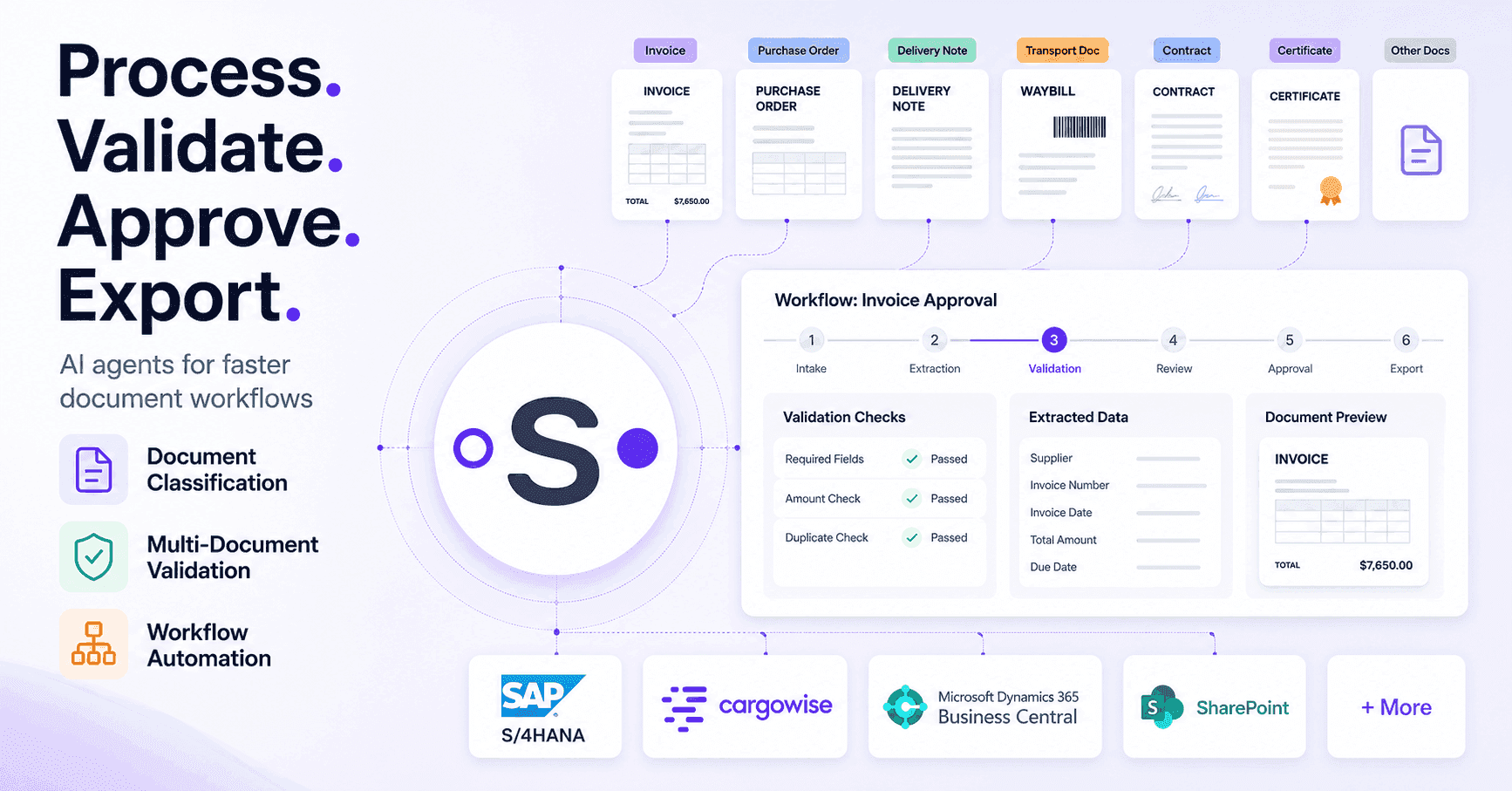
SenseTask uses AI agents to help teams classify documents, extract structured data, validate multi-document workflows, automate approvals, and prepare system-ready data for ERP and operational platforms. The result is not just faster extraction, but a more controlled and reliable document workflow from intake to validation and export.
Why Document Processing Is More Than Data Extraction
For many teams, the bottleneck is not simply reading information from a document. The real challenge is understanding whether that information is complete, accurate, consistent, and ready to move forward.
A single invoice may need to be checked against a purchase order, delivery note, goods receipt, contract, or approval rule. A transport file may include waybills, invoices, packing lists, customs forms, and supporting documents that must be reviewed together.
When these checks are performed manually, teams spend too much time switching between files, comparing fields, correcting errors, and deciding what needs human attention. This slows down approvals, increases operational risk, and creates unreliable data for ERP and business systems.
That is why modern document automation needs to go beyond extraction. It must combine document understanding, structured data extraction, multi-document validation, workflow automation, and controlled export into one connected process.
How AI Agents Accelerate Document Processing
AI agents help teams move faster by reducing the manual work required to classify files, extract information, validate data, and decide what should happen next.
Instead of treating every document as an isolated file, AI agents can support the full document workflow: identifying the document type, understanding what data matters, applying the right extraction logic, checking related documents, and preparing the result for approval or export.
For example, an AI agent can help determine whether a file is an invoice, purchase order, transport document, contract, form, certificate, or supporting document. Once the document is classified, SenseTask can extract relevant fields such as supplier details, invoice totals, line items, dates, references, shipment numbers, contract values, or expiration dates.
AI agents can also help teams work faster when new document types or layouts appear. Instead of starting from zero, the system can assist with understanding document structure, suggesting relevant fields, mapping labels to business concepts, and improving processing based on validation feedback.
The result is faster time-to-automation, less manual setup, and more consistent processing across suppliers, customers, departments, and document formats.
Multi-Document Validation Before Approval or Export
The biggest risk in document automation is not extracting the wrong field. It is allowing incomplete, inconsistent, or unvalidated data to move into approvals, ERP, accounting, logistics, or operational systems.
Enterprise document workflows often depend on relationships between multiple files. An invoice may need to match a purchase order. A delivery note may need to confirm quantities. A transport document may need to match a shipment reference. A certificate, authorization, or compliance document may need to be valid before a process can continue.
SenseTask helps teams validate documents individually and as part of a larger workflow. The platform can check required fields, compare values across related documents, identify missing files, detect inconsistencies, and apply business rules before approval or export.
This is especially important for processes such as invoice approval, purchase order matching, logistics document validation, supplier onboarding, contract review, construction documentation, and multi-document validation.
By validating data before it reaches downstream systems, teams can reduce rework, prevent manual corrections, improve approval speed, and ensure that exported data is structured, accurate, and ready for business use.
Faster Implementation for New Document Types and Workflows
One of the main reasons document automation projects slow down is setup time. Every new process may involve different document types, layouts, field names, validation rules, approval steps, and export requirements.
SenseTask helps accelerate implementation by reducing the manual effort required to configure classification and extraction models. AI agents can assist with document understanding, faster tagging, document type identification, field selection, and mapping document labels to business concepts.
This makes it faster to create custom models for document classification and key data extraction. Instead of manually reviewing every layout from scratch, teams can move faster from sample documents to structured fields, validation rules, and workflow automation.
For example, supplier invoices, transport documents, contracts, or construction authorizations may use different terminology, layouts, and formats. SenseTask helps standardize this information into structured fields that can be validated, reviewed, approved, and exported.
This reduces time-to-automation for new document types, suppliers, customers, departments, or business processes, while still keeping validation rules, approval flows, human review, and export logic governed inside the platform.
Keeping Control with Rules, Reviews, and Audit Trails
Speed matters, but enterprise document automation also needs control. Teams must be able to define what can be processed automatically, what requires human review, and what should be blocked before approval or export.
SenseTask combines AI-assisted document processing with configurable business rules, validation logic, approval flows, and exception handling. This means teams can automate routine document workflows while keeping control over sensitive decisions, compliance requirements, and operational exceptions.
For example, a document can be routed for review when a required field is missing, when an invoice does not match a purchase order, when a document is expired or close to expiry, or when an amount exceeds an approval threshold. Clean documents can continue through the workflow faster, while exceptions are flagged for the right person or team.
Every validation, correction, approval, and export step can be tracked through an audit trail. This gives teams visibility into how documents were processed, what changed, who approved them, and when data was exported to downstream systems.
The result is faster automation without turning document processing into a black box. Teams can increase straight-through processing while maintaining transparency, accountability, and business control.
The Business Impact: Faster Processing, Cleaner Data, and Better Decisions
When document processing is connected to validation and workflow automation, the impact goes beyond saving time on data entry.
Teams can reduce manual review, shorten approval cycles, catch errors earlier, and improve the quality of data that reaches ERP, accounting, logistics, procurement, and operational systems.
For finance teams, this can mean faster invoice processing, better purchase order matching, and fewer corrections before payment approval. For logistics teams, it can mean cleaner shipment documentation and faster validation of transport files. For operations and compliance teams, it can mean better visibility into missing, expired, or inconsistent documents.
AI agents help accelerate the repetitive parts of document work, while SenseTask keeps the process structured, traceable, and controlled. This allows teams to focus less on manual checking and more on exceptions, approvals, and higher-value decisions.
The result is a document workflow that is faster, more accurate, and better connected to the systems that run the business.
Conclusion
Teams that work with complex business documents need more than OCR and basic data extraction. They need a controlled way to classify documents, extract structured data, validate information across workflows, automate approvals, and export clean data to the systems that run the business.
AI agents can help accelerate this process by reducing manual setup, improving document understanding, supporting faster custom model creation, and helping teams move from unstructured files to validated, workflow-ready data.
SenseTask combines AI document processing, multi-document validation, configurable workflows, human review, audit trails, and system-ready export in one platform. This helps enterprise teams process documents faster while keeping control over accuracy, exceptions, approvals, and business rules.
For organizations dealing with invoices, purchase orders, transport documents, contracts, construction files, supplier dossiers, or other complex document workflows, the opportunity is clear: faster processing, cleaner data, fewer manual checks, and better operational control.
Ready to get started?
Start automating document processing and validation with SenseTask.